

Dr. Dan Stickler, MD
Co-Founder & Chief Medical Officer
“We’re not treating disease. We’re designing optimal function. That’s a completely different orientation.”
The difference isn’t resilience, mindset, or discipline. It’s written in three genes, and this free lesson shows you exactly how to read them.
Lesson 3.3: Stress Genetics · 30–45 minutes · Full curriculum depth · Free
No credit card. Instant access on submission.
The pattern
You’ve had clients who meditate, sleep well, exercise consistently, and still can’t get their stress response under control. You’ve also had clients who thrive under conditions that would break most people. You’ve never had the scientific framework to explain why.
The genetics
COMT shapes how quickly the brain clears stress hormones. FKBP5 shapes cortisol-receptor sensitivity: essentially, how hard stress hits at the cellular level. HTR2C shapes serotonin-receptor response and emotional reactivity. These three genes explain more about a client’s stress profile than any intake questionnaire ever will.
Who it fits
This lesson is for health coaches, wellness practitioners, performance coaches, and anyone working with burnout, chronic stress, or anxiety who wants a data-driven framework to replace guesswork.
Lesson 3.3 from the Mosaic Epigenetics Coaching Certification: same content, depth, and standard as every lesson in the program.
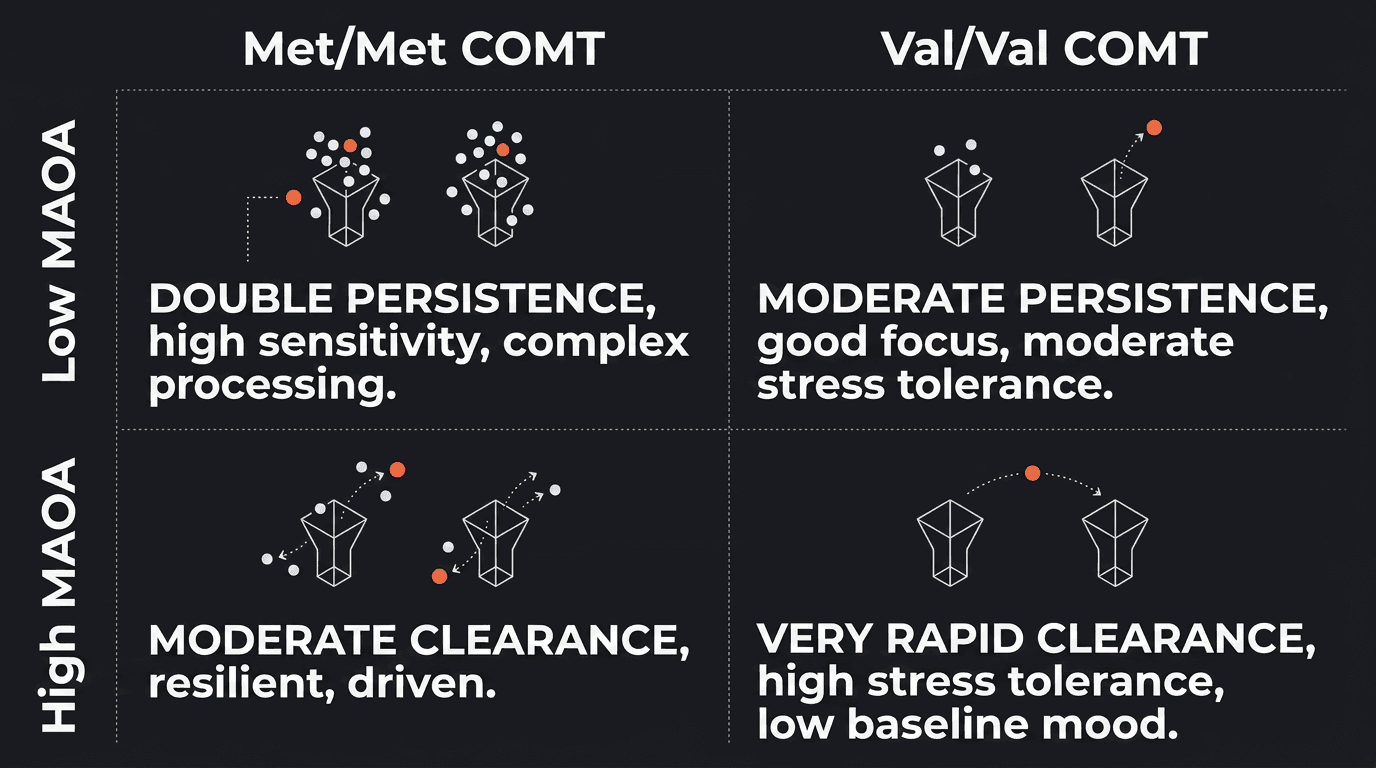
The enzyme that clears dopamine, norepinephrine, and epinephrine from the prefrontal cortex: why warrior and worrier variants exist, and what they mean for performance under pressure.
The gene regulating glucocorticoid-receptor sensitivity: why some clients have a hair-trigger stress response and struggle to return to baseline long after the stressor is gone.
Serotonin-receptor sensitivity and its role in anxiety, emotional reactivity, and mood regulation: the genetic link between stress response, sleep, and appetite patterns.
The research finding that changes everything: the same variants that increase stress vulnerability also increase responsiveness to every positive intervention. High sensitivity is a superpower with the right support.
The Keller study: 28,000 people, 8 years. What it revealed about stress beliefs, genetic predisposition, and mortality. And why how you talk to clients about stress is one of your highest-impact interventions.
How to individualize breathwork, HRV training, cognitive reframing, and environmental design based on each client’s specific stress-variant profile.
Co-Founder & Chief Medical Officer
“We’re not treating disease. We’re designing optimal function. That’s a completely different orientation.”
Enter your name and email to get the full lesson: video preview, lesson handout, and an onboarding sequence introducing you to the rest of the curriculum.
Each one is a complete certification-level lesson from a different chapter.
The full certification is open for enrollment now.