
Every patient report, read as one picture.
Your patients arrive with years of labs, hormones, gut, toxicology, and the Mosaic genome you order. Clara reads it all as one system, finds what’s driving what, and hands you a plan to review, edit, and implement.
$25/monthSee pricing
For licensed practitioners (MD, DO, NP, PA). Most requests reviewed within 24 hours.
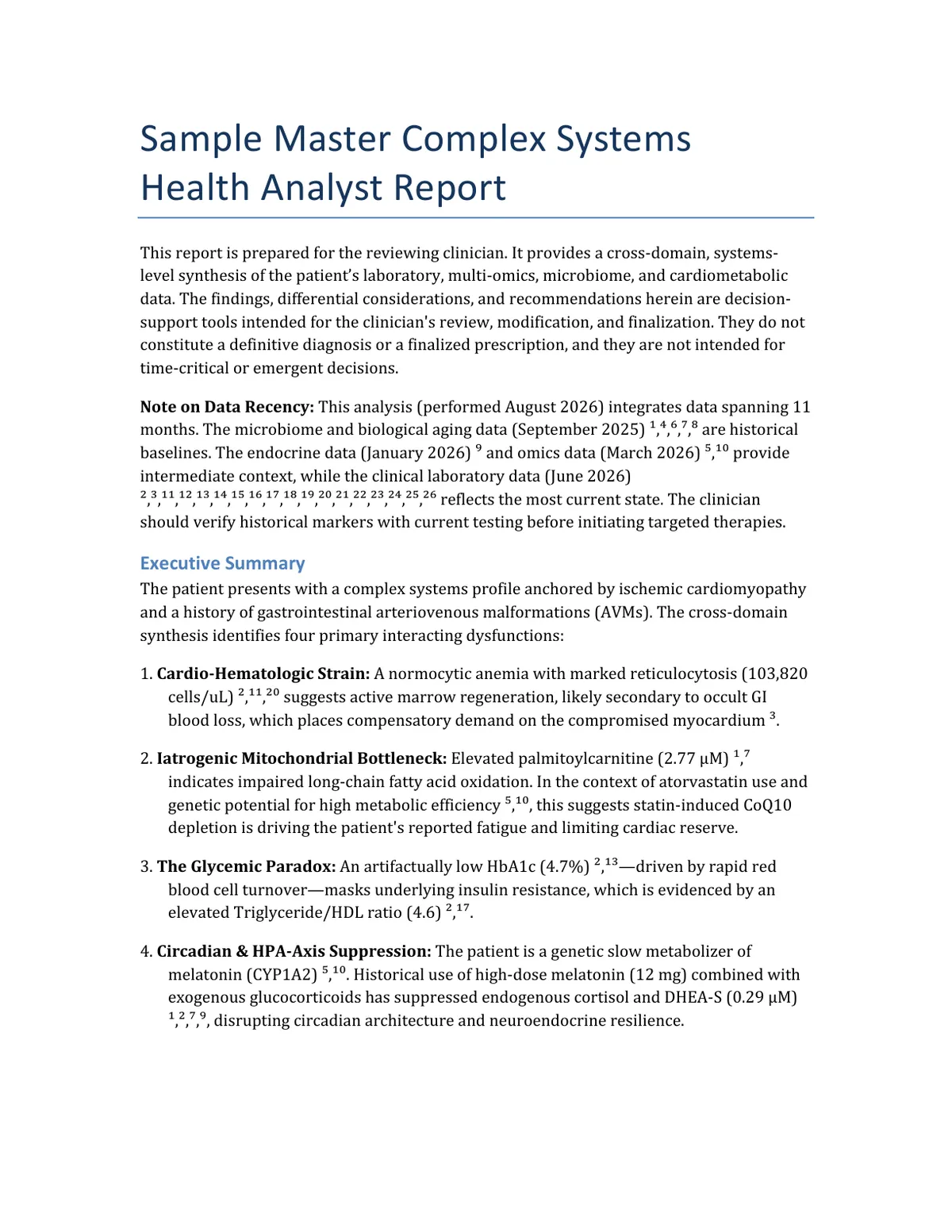 See a sample report
 See how the systems connect.
The synthesis maps the patient as a cascade: the upstream drivers, the amplifiers between, and the downstream findings they produce. Select any node to trace its path and read its basis. This is an illustrative sample from a de-identified patient.
Interactive systems health map: primary drivers, amplifiers, and downstream findings, with the relationships between them.
Every biomarker, tracked over time.
Values from every report a patient brings line up by analyte and date, graded against their reference range, so a slow drift shows before it becomes a finding.
- Hemoglobin↓ 12 g/dL
Out of range
2025-03 → 2026-03Ref 12–16 g/dL - Ferritin↓ 23 ng/mL
Out of range
2025-03 → 2026-03Ref 30–400 ng/mL - Fasting insulin↑ 13 µIU/mL
Watch · trend shifting
2025-03 → 2026-03Ref 2–20 µIU/mL - Hemoglobin A1c↑ 5.5 %
In range
2025-03 → 2026-03Ref ≤ 5.6 % - hs-CRP↓ 1.1 mg/L
Watch · trend shifting
2025-03 → 2026-03Ref ≤ 3 mg/L - Vitamin D, 25-OH↑ 38 ng/mL
In range
2025-03 → 2026-03Ref 30–100 ng/mL
Out of rangeWatch · trend shiftingIn range· shaded band = reference range · synthetic values for illustration
Clara does the reading. The clinical judgment stays yours.
The specialists and the master analyst run on their own. You review, edit, and approve the final Systems Health Map, then implement it. Every recommendation shows the inputs and citations behind it, so you evaluate it independently.
- Step 01
Upload
Add a patient’s interpreted lab and assessment reports: PDFs, report images, or CSVs. No raw imaging or sequencing files.
- Step 02
Clara reads
Only the domain specialists your reports call for run, then the master analyst maps how it all connects. The analysis runs on its own.
- Step 03
Review and implement
You review the Systems Health Map, edit it, and sign the PDF. Every finding shows its basis: decision support, not a black box. The plan, and how you implement it, stay yours.
A panel of domain readers, then a systems analyst.
Clara sends each report to the specialists that read that kind of data, from blood chemistry to the microbiome to the genome. The master analyst then reads their findings together and maps how one system is driving another.
Clinical Laboratory
Blood chemistry, CBC, and metabolic panels: the everyday labs, read in the context of everything else.
Cardiometabolic
Lipids, glucose and insulin dynamics, and the markers that track metabolic and cardiovascular health together.
Microbiome
Stool and oral microbiome panels such as GI-MAP and Gut Zoomer, for what the ecosystem is doing.
Toxicology
Heavy-metal, environmental-toxin, and mycotoxin reports: the exposure load underneath the picture.
Precision Omics
Genomic and methylation report findings, including a Mosaic Genomic Lifestyle Optimization Report when there is one.
Neurocognitive
Cognitive, neurotransmitter, and mood-related assessments: the nervous-system layer.
Body Structure & Movement
Body-composition, musculoskeletal, and movement assessments: how the structure holds and moves.
Allostatic Load
The cumulative wear of chronic stress across systems, the load a single panel never shows on its own.
Biological Aging
Epigenetic and biological-age clocks: the pace of aging against the calendar.
Mitochondrial
Energy-metabolism and mitochondrial-function markers: the cellular engine room.
Psychosocial & Lifestyle
Sleep, stress, nutrition, and lifestyle context: the daily inputs that move everything else.
The synthesis
Master Complex Systems Health Analyst
Reads the specialist reports together and maps how the systems connect: which upstream drivers are producing which downstream effects, and where an intervention would do the most.
See a sample Clara reportClinical data, handled like clinical data.
Patient data is encrypted, access is scoped to each provider and practice, and it is handled under a Business Associate Agreement (BAA). Clara reads interpreted reports only, never raw imaging, waveforms, or sequencing files.
More on the workflow and safeguards in the Clara FAQs.
Want a closer look first?
See it on the panels you run, or ask a question. We reply within one business day. Ready to start? Request an account.
See the whole patient at once.
Clara reads across every interpreted report you already order and shows you where to intervene for the most impact. You weigh it, edit it, and implement.